How Can AI Build Faster and Better Silicon for Physical AI?

The age of physical AI is here, and with it comes a significant increase in the demand of custom silicon.
By 2025, five million industrial robots were operating worldwide. As these systems become more capable, their demands on silicon become more distinct. Each must balance computation and memory with the realities of power, latency, reliability, and security.
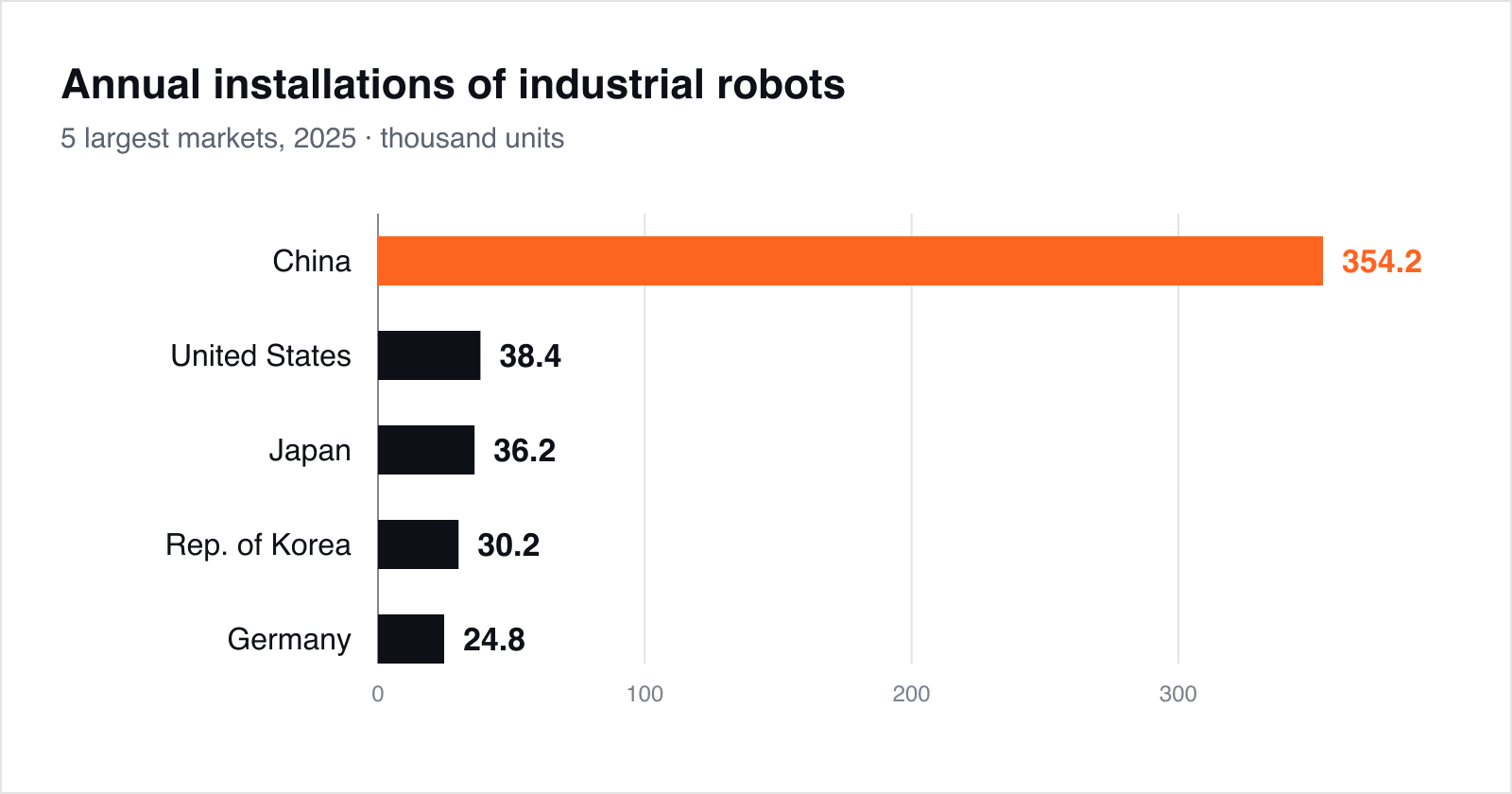
Figure 1. Annual installations of industrial robots, 5 largest markets, 2025. Source: International Federation of Robotics, World Robotics 2026. Chart redrawn by ChipAgents.
For humanoid robots in particular, application-specific hardware can provide the agility and speed required to perform specialized tasks in real time. As those requirements diverge, specialized ASICs become more attractive, because they can be optimized for the exact workloads, latency targets, power envelopes, and operating environments of a particular system.
The constraint to this innovation is development speed: AI models and software evolve faster than the conventional silicon tape out cycles, creating a need to accelerate the entire path from design intent and exploration to physical implementation and validation.
For agentic AI to deliver that acceleration, it must meet three requirements.
No.1 Persistent design context
Agents need a shared, persistent representation of the design and the engineering knowledge behind it. A design ontology provides structure: it connects design flows, RTL design, verification, verification tools, error diagnosis and repair, synthesis, timing, and PPA optimization methodologies. Organization-specific methodologies and prior decisions add the rationale for how the design should evolve. To remain useful across tasks, this context must track provenance, design versions, and dependencies, so agents can distinguish current evidence from assumptions or superseded results.
Consider a 3D IC, where logic, memory, die-to-die interfaces, packaging, power delivery, and thermal behavior are coupled. An RTL change that preserves functional behavior can alter switching activity, placement, or interconnect demand, affecting timing, power integrity, and temperature after implementation. Persistent context helps agents trace those dependencies across die and system boundaries, identify which analyses and verification results may no longer be valid, and invoke the appropriate tools to reassess them. AI then also converts improvement from specific cases into reusable knowledge, helping reduce recurring mistakes and repeated investigation across similar tasks.
No.2 Long-horizon workflow execution
Second, agents must carry design objectives through many dependent steps, measuring progress against verified engineering outcomes: functional correctness, physical feasibility, and target power, performance, and area within schedule and compute budgets.
Novel architectures for physical AI introduce more configurations, interfaces, and corner cases. Accelerating individual tasks delivers limited value if downstream verification or physical implementation cannot converge. Every action must therefore serve the overall objective, with explicit acceptance criteria guiding execution and determining when the work is complete.
This requires co-optimizing models, tools, and compute across the workflow. Complex reasoning may benefit from a larger model, repeatable operations from deterministic procedures, and numerical analysis from specialized engineering tools. CPU and GPU allocation, memory capacity, and parallel execution must be selected according to their contribution to the final result. The relevant measure is total time and cost to a validated outcome.
No.3 Verifiability and security
Third, all systems produced must be held to a critical standard of verifiability and security.
Physical AI applications operate in the real world, often in environments where failures can create direct safety risks. Specialized hardware also introduces hardware-specific security requirements and potential vulnerabilities that must be identified and verified before deployment. Agentic AI can help automate portions of that process by checking implementations against security requirements, surfacing potential vulnerabilities, and generating additional verification scenarios. That being said, to achieve an entirely autonomous workflow, you need traceable decisions, reproducible tool runs, explicit verification assumptions, and engineer review and signoff. Trust in this system is dependent on the evidence supporting each engineering decision.
At ChipAgents, we’re building toward a question: what would it take to make chip development 10× faster? Our approach brings organizational design ontology, physics-aware models, and LLM agents together in IC-STAR, the chip neural engine powering our platform. We study how models and multi-agent orchestration can work together to reach verified outcomes faster, with lower inference cost. Our ambition is shortening the path from design intent to verified implementation could put custom silicon within reach of more teams, opening new possibilities for machines that sense, move, and act. We see a future where more engineering ideas make it beyond the drawing board and into the world.