
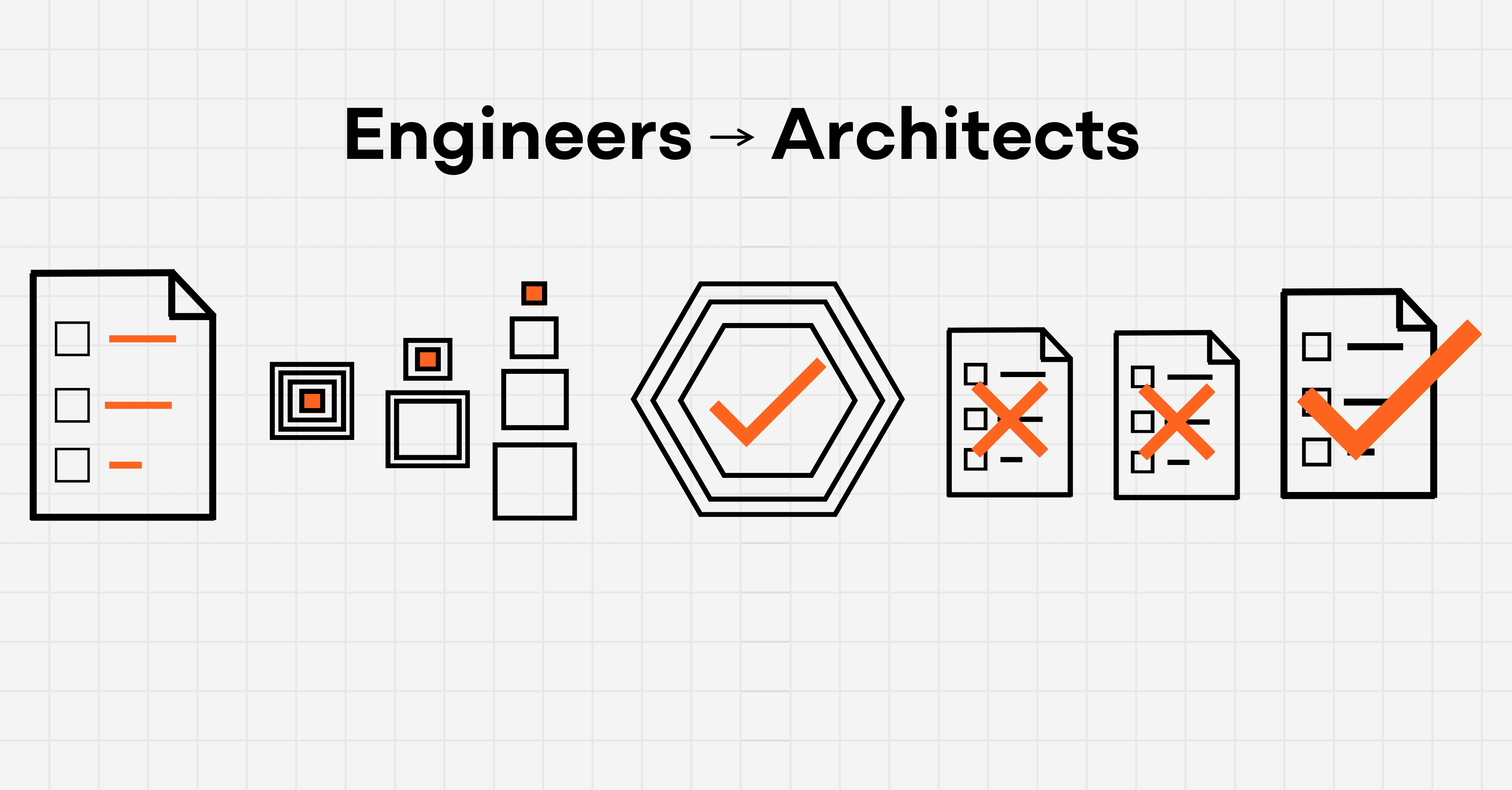
How Agentic AI Turns IC Engineers into Architects

Software engineering has already undergone a strange transition: everyone is coding, but increasingly, nobody is typing.
AI coding tools have evolved from autocomplete into agents that take a natural-language request, inspect a codebase, make changes, run tests, and iterate on their own — and in software, this shift has happened remarkably fast.
Chip design is next; but the transition will be slower, harder, and potentially far more consequential.
As the semiconductor industry adopts AI-native chip design workflows, the biggest change will not simply be faster RTL generation, testbench creation, scripting, or debugging. Engineers will need to learn a fundamentally different way of working. Instead of executing every step themselves, they will increasingly manage intelligent end-to-end systems that execute work on their behalf. In other words, the engineer's role moves upward: from writer, to reviewer, to orchestrator, and ultimately, to architect.
Surprisingly, Chip Design Managers Have Been "Vibe Coding" for Decades
"Vibe coding" sounds like a new idea: describe what you want in natural language, delegate implementation to an intelligent system, inspect the result, and iterate.
But one profession has worked this way for decades: engineering management.
A manager describes what they want through specifications, tickets, emails, and meetings. They delegate implementation to engineers whose internal reasoning they cannot completely observe. When the work comes back, they review the result, check whether it satisfies the requirements, and decide whether to accept it.
When you replace the human engineer with an AI agent, the workflow looks surprisingly similar. In consequence, engineers using agents suddenly inherit a set of traditionally managerial responsibilities:
- Writing specifications that cannot be misunderstood
- Deciding what context each agent needs
- Decomposing a problem into independent pieces
- Evaluating work rather than producing all of it themselves
- Coordinating multiple specialized agents
- Knowing when an apparently reasonable result is actually wrong
This means that AI doesn't eliminate engineering management, but democratizes it. Every engineer working with agents becomes, in some sense, the manager of an increasingly capable engineering team.
Why Chip Design Is the Boss Level for AI Agents
Software offers an early preview of this future. But AI agents for semiconductor engineering operate in a much more difficult environment.
The first problem is data.
Software models benefit from enormous public codebases and decades of open-source development. Semiconductor design data is far scarcer and, in many cases, proprietary. In our own analysis, digital-design projects were orders of magnitude less common than Python repositories, while publicly available analog design data was scarcer still.
The second problem is that chips do not speak English.
Chip engineers work with schematics, netlists, graphs, placement and routing, waveforms, parasitics, design rules, and device physics. These are structural, spatial, temporal, and physical representations, not merely text waiting to be placed into a context window.
Fortunately, semiconductor engineering has spent decades building tools that do understand these representations. Through simulators, formal tools, physical-design tools, and timing engines, chip design is handled in its own language.
That means an AI agent doesn't need to internalize all of this knowledge itself. It only needs to learn which tool to ask, how to use it, and how to interpret the answer.
That is why the most powerful architecture for AI chip design will not be an LLM operating alone. It will combine the semantic reasoning of foundation models with semiconductor-specific context, specialized engineering tools, and automated verification.
The Bottleneck Moves From Writing to Reviewing
Once agents become good at implementation, something counterintuitive happens.
With an increase in generation, comes a scarcity in review.
Where an engineer might once have spent hours writing several hundred lines of RTL, an agent can generate multiple implementations in minutes. Ten agents can generate ten approaches simultaneously. One hundred agents could potentially explore one hundred.
But the engineer still has only one pair of eyes.
This creates an Amdahl's Law for AI engineering: generation can scale horizontally, while human review remains largely serialized.
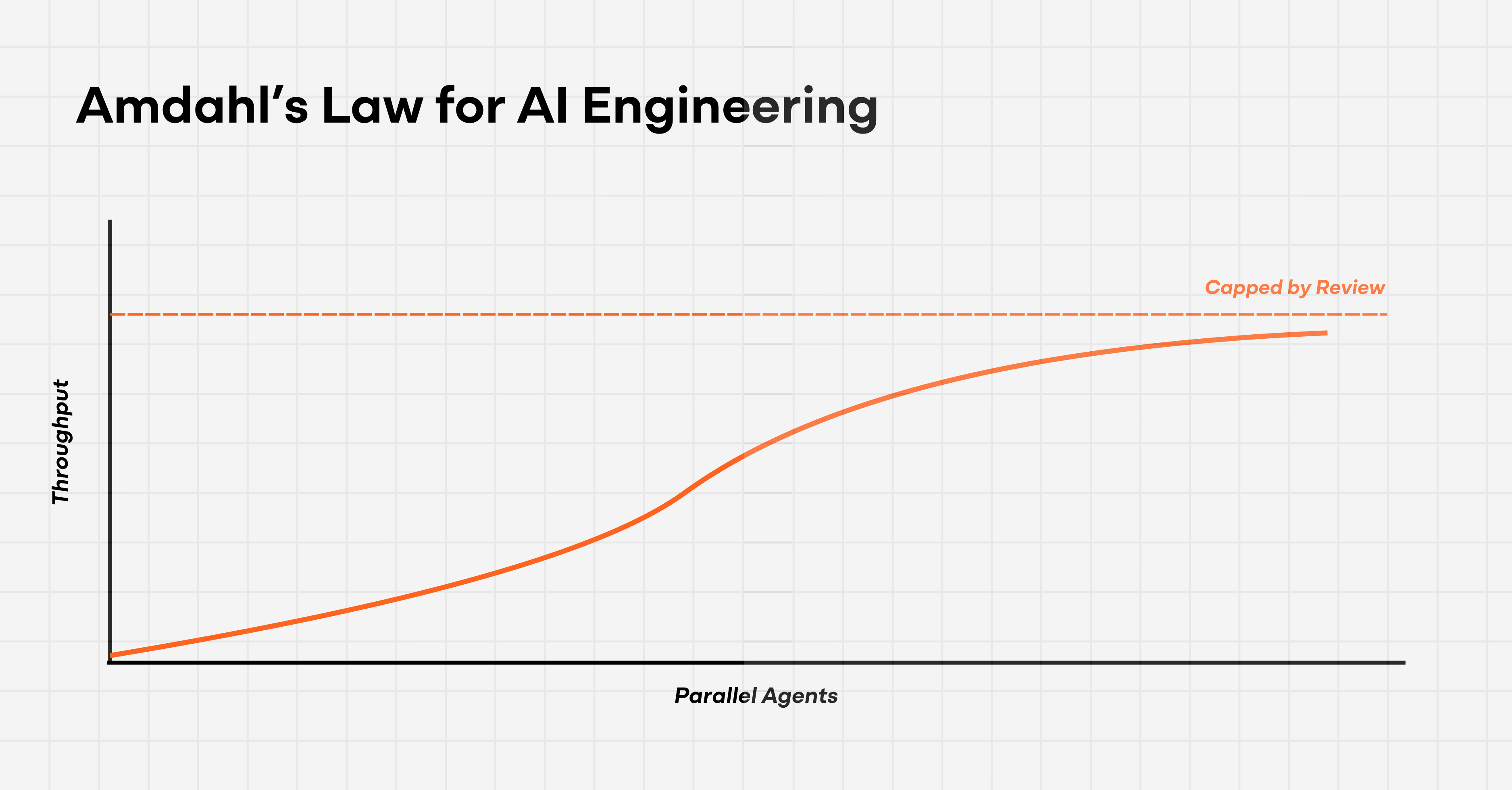
Figure 1. Amdahl's Law for AI Engineering
In this transition, the bottleneck shifts from writing to reviewing; explaining one of the most dangerous properties of engineering agents – being almost right.
In software, an almost-right solution may cause a failed test, a rollback, or an unpleasant afternoon. In silicon, almost right can become a mask set.
This means the goal cannot simply be to generate more; but to build systems that can generate, evaluate, reject, and improve solutions without requiring a human to manually inspect every intermediate output.
Search Is Where AI Agents Become Powerful in Chip Design
Some of the most promising problems for agentic AI share two characteristics:
The search space is enormous, but the outcome can be evaluated automatically.
These problems are everywhere in chip design: from debugging to PPA optimization, architecture exploration, parameter tuning, and verification.
Consider an RTL debugging problem. There may be hundreds of signals, thousands of relevant lines of RTL, many potential cycle interactions, and dozens of plausible explanations for a failure. A human engineer cannot investigate every hypothesis simultaneously.
AI agents can. And that changes the economics of design exploration. Generating 1,000 candidates is useful because we often have tools capable of determining which candidates work. The verifier effectively becomes the reviewer.
Where traditional algorithms search over structure: signals, states, parameters, and graphs, LLM agents add another dimension. AI agents can search over semantics; forming hypotheses about what a block is supposed to do, what an engineer may have intended, or why two pieces of a system interact incorrectly.
Combine semantic reasoning with traditional engineering search and specialized verification tools, and AI can begin exploring engineering spaces that were previously too large, slow, or expensive to traverse.
From Single-Threaded Engineers to Multi-Threaded AI Workflows
The natural consequence is a different model of engineering.
Today, an engineer generally works like a single-threaded program: understand one problem, form a hypothesis, implement something, test it, and repeat.
Tomorrow's engineer can be multi-threaded.
One agent investigates the waveform. Another traces the relevant RTL. Several generate competing root-cause hypotheses. Others test those hypotheses against simulation or formal tools. A judge ranks the results, and the engineer sees only the strongest candidates.
Instead of personally traversing every branch of the search tree, the engineer manages the search.
We are already building systems around this principle at ChipAgents. In root-cause analysis, for example, multiple agents can investigate different parts of an SoC and different hypotheses in parallel before presenting a filtered set of likely causes to the engineer.
The engineer is no longer simply doing the work; they are designing how the work gets done.
The Engineer Becomes the Architect
When implementation becomes cheap, value moves upward.
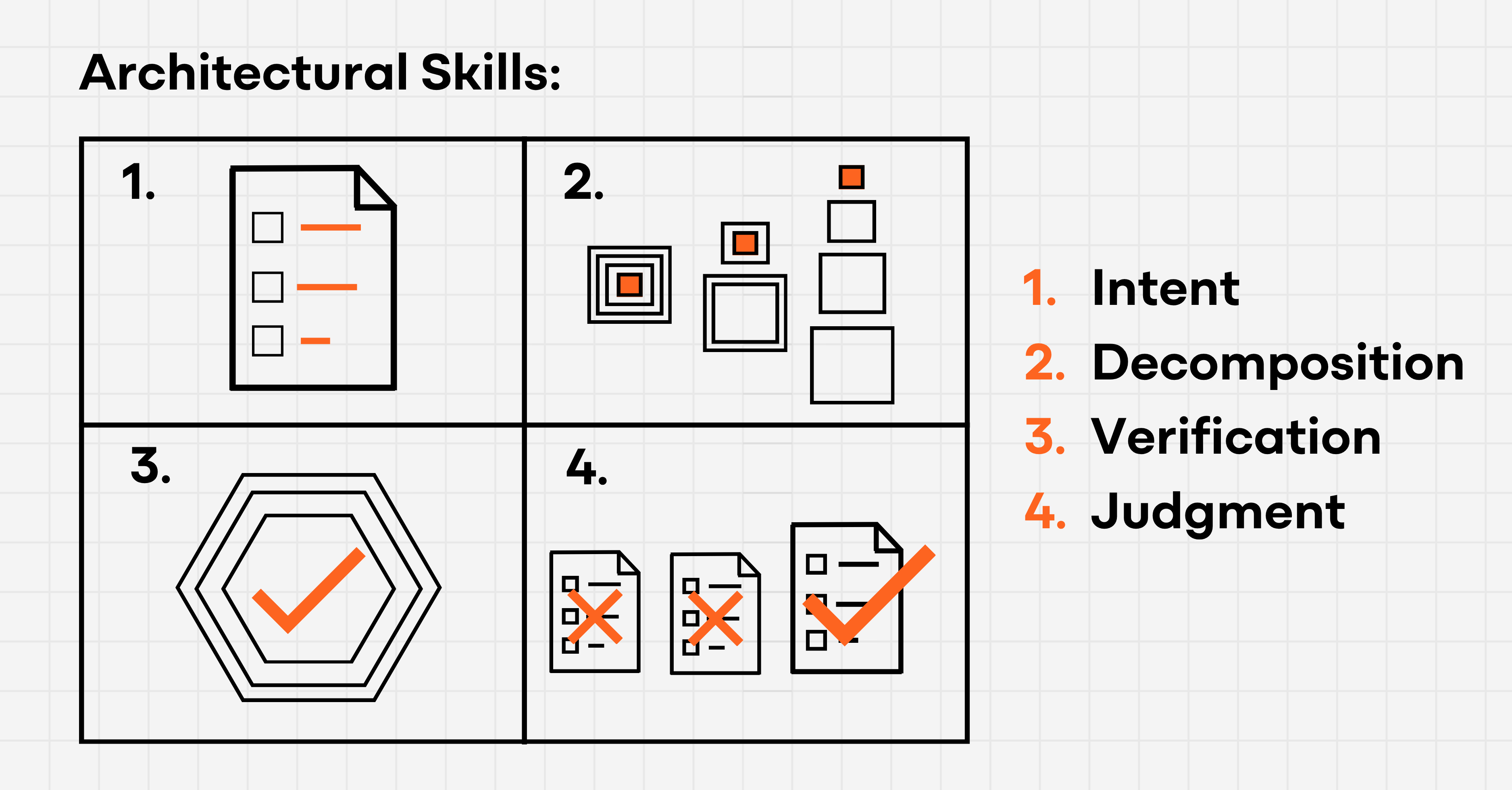
Figure 2. Four architectural skills required for AI-native engineers
The scarce skills become:
- Intent: defining precisely what should be built.
- Decomposition: breaking large systems into problems that humans and agents can independently solve.
- Verification: defining what "correct" actually means and constructing feedback loops that detect almost-right solutions.
- Judgment: understanding tradeoffs and choosing which of several technically valid designs should ship.
These have always been architectural skills.
This has implications not only for experienced engineers, but also for how we train the next generation. Junior engineers traditionally develop judgment by spending years doing implementation work. If agents increasingly perform that groundwork, we need new ways to teach engineers the intuition that groundwork once provided.
Fundamentals therefore become more important, not less. You can safely delegate a task only if you understand the system well enough to recognize when the delegate is wrong.
The Future of Agentic AI in Semiconductor Engineering
In the agentic AI era, the fundamental unit of engineering work begins to change: from one task executed by one engineer to many hypotheses explored in parallel by intelligent systems.
And the engineer moves from doing every step of the work to designing the system that gets the work done.
Software was the preview.
Silicon is where this gets interesting.