

AI Agent-Driven Timing Closure


Why faster validation loops matter
Timing closure is a byproduct of limited visibility in early stages. An engineer restructuring logic or moving a register boundary at RTL can only predict whether the edit helps. They may budget a day for synthesis and static timing analysis to deliver an estimate. But a full picture often isn't an option, as physical design tooling can take weeks and demands expertise from multiple teams. This forces timing improvements in early stages to rely on a small number of authoritative measurements, often placing bottlenecks on later stages.
We build AI agents for hardware design, and the same constraint binds them. An agent works as a loop, taking an action, observing the result, and adjusting before acting again. When the observation takes hours to days, the loop has a lower iteration budget and becomes less effective. The reason agents are rapidly improving at frontend tasks, yet still struggle with back-end flows lies in the absence of quick, representative feedback. In this article, we explore how ChipAgents builds loops to accelerate timing closure.
What are loops?
At the core of agentic AI sits a large language model.
The first wave of large language models operated as conversational systems. A user lugged their context into a web interface, the model generated a response, and the user would decide whether to continue engaging. While prompting techniques and fine tuning reduced hallucinations, models were fundamentally limited to the context provided to them.
To address this limitation, the agent loop was built.
An agent relies on tools to ground itself in its environment. Rather than generating a one-shot response to a question, it can live directly where you develop. It might inspect a codebase, make an edit, test the change, and reason over the result before responding to a prompt. This environment interaction shifted the role of AI from a static oracle to an assistant that can execute tasks.
Tool access alone, however, does not guarantee a correct outcome. As a task grows longer, small deviations accumulate. An agent may produce functionally valid RTL, but did it deviate from the initial plan across iterations? Or did it unintentionally bloat the design, sacrificing throughput on its course to achieving functional correctness?
The truth is, most stages in designing a chip are multi-objective. To stay aligned with the engineer's intent, agents need a validation loop to guide them. In other words, a well-defined check that measures whether each iteration is moving toward the actual goals outlined by the human.
Timing closure: A system of loops
The chip design process is often presented as a linear sequence, but can also be represented as a set of nested task-and-validation loops.
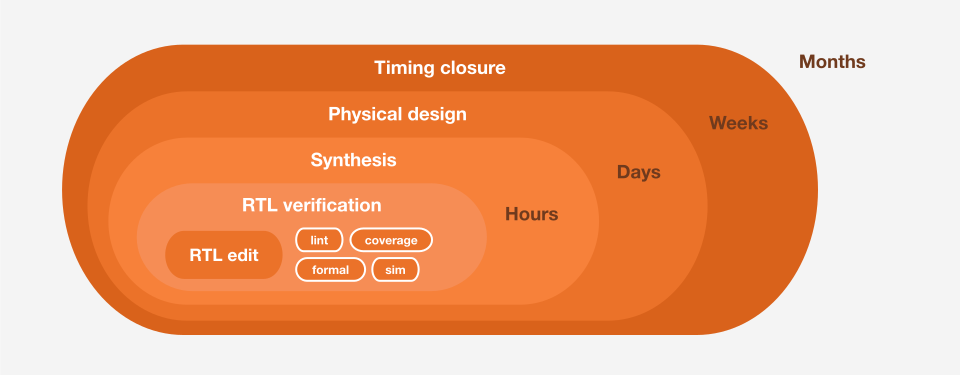
As validation moves outward from RTL to timing closure, the cost of validation increases from hours to months.
The atomic building block is an RTL edit, introducing the first set of boundaries over the solution space. As teams take the design on the path to sign-off, each stage involves some set of artifacts that are iterated over using a set of validation tools. As we step into outer loops, like physical design and timing closure, the time required to receive feedback from these tools increases, along with the cost of having to step back to an inner loop.
The cost of slow loops
Viewing the stages in closing timing as loops, it becomes clear that the types of problems that generic LLM agents struggle with are ones where the feedback of their decisions lives more than a loop away. While RTL verification offers feedback within hours, finding timing violations traditionally requires running synthesis and Static Timing Analysis (STA).
We compared three ways AI can approach fixing a timing violation at RTL.
A standalone LLM is limited to the context provided in a single prompt, making it difficult to capture all the information required to make a functionally correct fix that improves timing in one shot.
An agent loop provides tools to explore and interact with the codebase, but still has no method to evaluate the impact its changes will have on timing. Until the design is synthesized, it does not know how an edit affects critical paths, power, or area.
Adding a validation loop, however, turns each attempt into experience. For example, an outer loop of running synthesis and STA allows the agent to test a hypothesis, observe why it helped or hurt, and use that evidence to choose the next action.
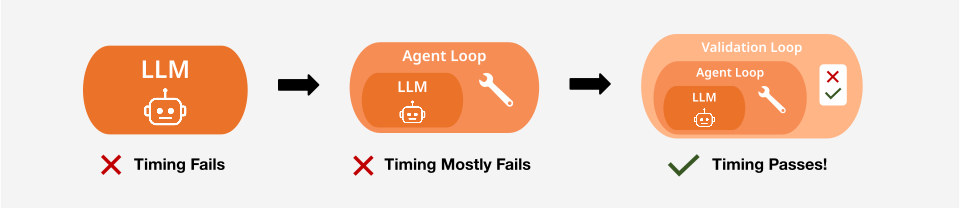
An LLM alone lacks context, an agent gains tools, and an agent with validation converges on its goal.
Giving the agent the same validation loop as an engineer, we found the agent capable of solving timing violations. But while running synthesis and STA provide a valuable signal for improvement, it can take hours or days to retrieve this feedback.
Slow validation loops creates four practical problems:
- The downstream consequences of a decision are difficult to predict.
- The cost of a fix grows dramatically when an issue escapes into a later stage.
- Multiple edits are batched into each expensive run, making it harder to identify which change helped or hurt.
- Limited iteration budgets enforce a focus on convergence and survival, potentially leaving better power, performance, and area (PPA) on the table.
AI agents make the bottleneck even more apparent. While they can edit in seconds to minutes, the feedback on their changes takes hours to days to arrive.
Building faster loops
To address the issues of long validation loops, we build faster inner loops. Our first step to accelerating the path to timing closure is providing the agent with fast PPA feedback at RTL.
In minutes, the agent can compare alternatives, reject timing fixes that create unacceptable power or area regressions, and keep approaches that move the design in the right direction. This trial-and-error process explores alternatives more efficiently and converges faster on a solution that balances timing, power, and area when the appropriate feedback is available.
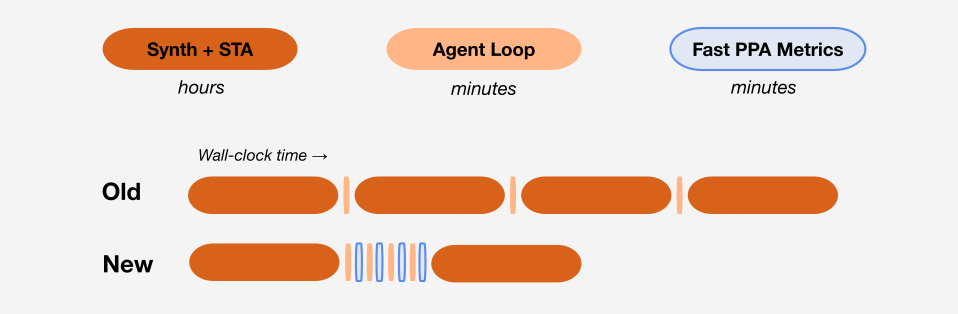
Fast PPA feedback lets the agent evaluate multiple RTL changes between trusted synthesis and STA runs.
The feedback critically does not replace trusted tooling, but rather makes iteration more intelligent. Full synthesis and STA still establish the baseline and confirm the result. The fast inner loop provides direction at edit speed, catches PPA issues earlier, and replaces batched feedback with evidence per edit to enable a shorter path to the optimal timing fix.
PPA-aware RTL implementation aims to not only reduce the number of iterations on synthesis, but also to reduce the workload of timing closure in physical design and during ECO campaigns.
The road to autonomous chip design
Providing fast PPA insights at RTL is one instance of our methodology at ChipAgents. Every stage of chip design pairs a task with a validation loop to iterate against. We began with workflows for coverage closure, formal verification, analog behavioral modeling, and root-cause analysis. The validation loops for these frontend verification tasks turn around in minutes to hours and agents thrive wherever feedback is fast.
When validation is too slow for an agent to exploit, faster inner loops are essential to restore the agent's capabilities gained through iteration. Timing optimization at RTL is our first step into the slow loops, where authoritative feedback takes hours to days and a fast inner signal has to be built rather than found.
The ChipAgents stack is built around loops. At the center sits Renoir, our hardware-native large language model, that is fast and cost-efficient. The ChipAgents CLI wraps Renoir in an agent loop, grounding it in the design environment with domain expertise and an interface to both custom and external tools. Fast EDA loops give that agent validation, such as PPA feedback, at edit speed. Finally, workflows keep the whole system aligned with human intent. Engineers define the objective, constraints, and stopping conditions, then steer the work, review artifacts, and confirm the result.
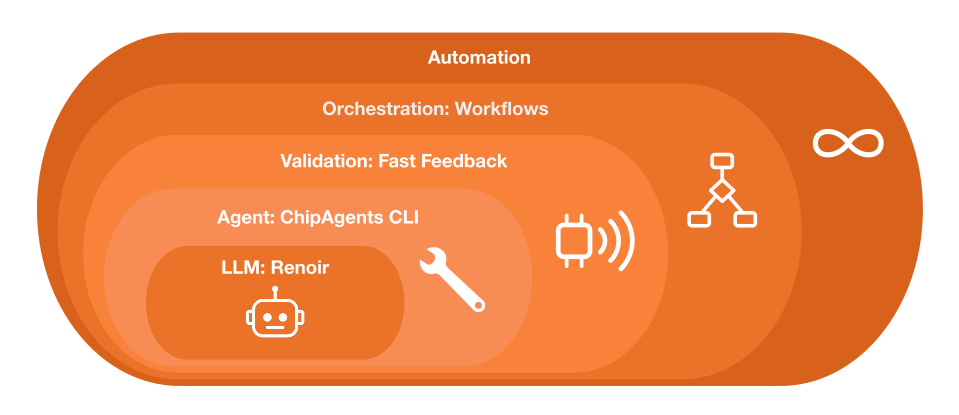
ChipAgents connects a hardware-native LLM, agent tools, fast validation loops, and workflow orchestration.
Each of these workflows closes a single stage of the flow. What connects the stages today is manual effort: an engineer carries the verified design into synthesis, walks the failing timing report back to the RTL that caused it, and decides what runs next. Automation, the outermost loop of the ChipAgents stack, makes those handoffs part of the system itself. One workflow's validation artifact becomes the next workflow's starting input. Connected end to end, the flow stops being a sequence of stages and becomes a single loop from spec to tapeout.
Through the large language model, the agent, fast validation loops, workflows, and automation, ChipAgents is working towards full-flow autonomy by closing one of the most complex loops in the world: chip design.