
What is AI-Native Flow for Chip Design

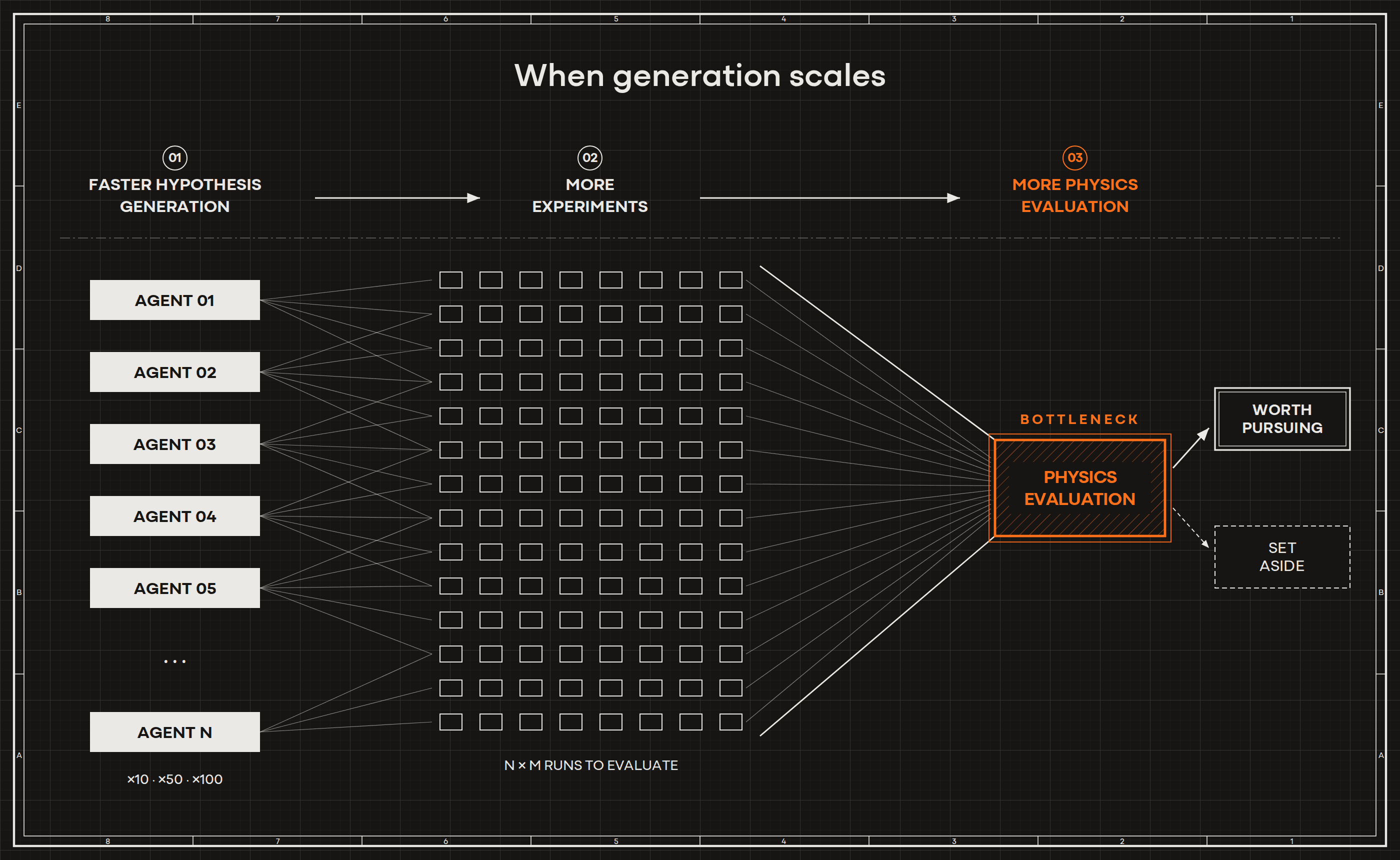
What happens when the capacity to generate hypotheses can outpace the capacity to evaluate them? As agents gain the ability to execute long-horizon workflows in parallel, IC design faces a new scaling challenge: every additional hypothesis creates demand for physical evaluation.
That question is becoming more urgent as 3D IC architectures expand the design space while making physical tradeoffs more tightly coupled. In a recent talk by Mehir, ChipAgents’ Head of Engineering, he identifies the challenging multi-physics coupling among thermal behavior, timing, power, and electromigration/IR drop in 3D IC systems. A change that improves one objective can create problems elsewhere. These trends point toward a potential bottleneck: the ability to explore designs could outpace the ability to determine which ones will work.
Traditional workflows were largely designed around human-scale iteration.
In many traditional workflows, engineers set the pace: make a change, configure the tools, launch a run, review the results, and decide what to try next. Automation already accelerates parts of this loop, but individual simulation runs are expensive and the number of experiments is naturally constrained by the speed at which engineers can create and evaluate them.

The introduction of multi-agent systems changed this dynamic.
If ten, fifty, or one hundred agents can generate implementations simultaneously, the number of experiments that need to be evaluated can also increase dramatically. The bottleneck may no longer be generating the next hypothesis or implementing it. The bottleneck becomes determining which of those implementations are actually worth pursuing.
In other words:
Faster hypothesis generation → More experiments → More physics evaluation
If every experiment requires a full signoff-grade flow, much of the benefit of parallel exploration can disappear as fast as it arises. Verification, analysis, compute infrastructure, and reporting simply become the next serialized bottleneck.
This creates demand for a different class of engineering tools: extremely fast estimation.
Not Every Hypothesis Needs Signoff Accuracy
The objective of these tools is not necessarily to predict the final result with perfect accuracy, but rather to eliminate bad trajectories as early and cheaply as possible.
In the case of a multi-agent system that generates 100 potential implementations for improving a design: running full signoff analysis on all 100 implementations would be expensive and potentially unnecessary. Most of the candidates may be obviously worse than the baseline or clearly inferior to other approaches.
Instead, imagine an estimator that runs 100X faster than the signoff flow but produces results that may be 20% or 30% away from signoff accuracy. For a human engineer preparing a final engineering report, that level of error may not be acceptable.
But, for an agent deciding which 90 of 100 experiments to discard, it could be enormously valuable.
The workflow might look like this:
100 hypotheses → Fast coarse estimation → 10 promising candidates → Higher-accuracy estimation → A few finalists → Signoff

The first layer does not need to determine exactly how much power an implementation will consume or precisely where timing will land. It needs to answer a simpler question:
Is this trajectory promising enough to justify more compute?
Perhaps 90 candidates can be eliminated almost immediately.
The remaining ten can then move into a more accurate analysis layer that gets within 5% or 10% of signoff. From there, only the handful of implementations demonstrating meaningful improvement need to enter expensive signoff-grade analysis.
This turns physical evaluation into a hierarchy of decisions, with increasing fidelity as the search narrows.
Speed Matters Only If It Preserves Useful Decisions
This distinction matters because humans and autonomous agents consume engineering tools differently.
For an engineer who runs an analysis because they need to understand the result, make a decision, or produce a report; accuracy carries enormous value.
Meanwhile, an autonomous system exploring a large search space often has a different objective. Initially, it may only need enough information to rank alternatives.
A 20% error delivered in seconds can sometimes be more useful than a 2% error delivered hours later if the faster result allows an agent system to eliminate dozens of unproductive paths.
As agent parallelism increases, this tradeoff becomes even more important.
The relevant optimization target for an engineering tool may no longer be:
How accurate is the result?
It will increasingly become:
How much useful information can the tool provide per unit of time and compute?
This is a different way of thinking about chip design infrastructure, but one that could prove essential to the new age of Agentic AI. Signoff accuracy remains essential at the end of the process. Earlier stages can use different levels of fidelity, provided those levels are appropriate to the decisions they support.
An AI-Native Infrastructure for Agents
The semiconductor design industry has spent decades building sophisticated tools around the underlying physics of semiconductor design: timing, power, voltage drop, thermal behavior, signal integrity, and many other physical effects.
That existing infrastructure gives autonomous engineering systems an enormous advantage. Agents do not need to reinvent semiconductor physics; they can interact with the analysis and implementation infrastructure the industry has already built.
That being said, multi-agent orchestration may also create an opportunity for a new category of engineering tools. While traditional tools were built primarily around human users, future tools may increasingly be built around machine consumers.
An AI agent does not necessarily need the same interface, latency profile, reporting format, or accuracy tradeoff as an engineer sitting in front of a workstation.
Instead, an agent may prefer a tool that is:
- available almost immediately,
- easy to invoke programmatically,
- inexpensive enough to run hundreds or thousands of times,
- directionally accurate rather than signoff accurate, and
- explicit about uncertainty or confidence.
Despite this shift, traditional signoff tools are no less important. Signoff remains the final authority because the handful of designs that survive autonomous exploration still need rigorous validation.
But underneath signoff, a new hierarchy of agent-oriented physics tools could emerge:
Fast screening → Higher-fidelity estimation → Signoff
As autonomous systems become capable of exploring larger design spaces, the ability to generate hypotheses may stop being the limiting factor. Their effectiveness will increasingly depend on how intelligently they allocate evaluation effort.
The next challenge will be evaluating those hypotheses fast enough to keep up, changing not only how engineers use EDA tools, but how the tools themselves are designed.